
Artificial intelligence or AI is no longer confined to laboratories and tech companies; it is now producing paintings, music and literature at unprecedented speed. As AI-generated works enter competitions and galleries, artists are increasingly divided over whether this new medium represents innovation or imitation.
“AI is never going to be expressive or creative,” Professional Artist Kelly Porter said. “It’s always going to be taking an instruction.”
As AI has become more and more advanced, one of the biggest concerns has been whether it’s going to overtake traditional artists. Whether it be jobs, commissions, or personal projects, artists have been increasingly worried about AI taking away their opportunities.
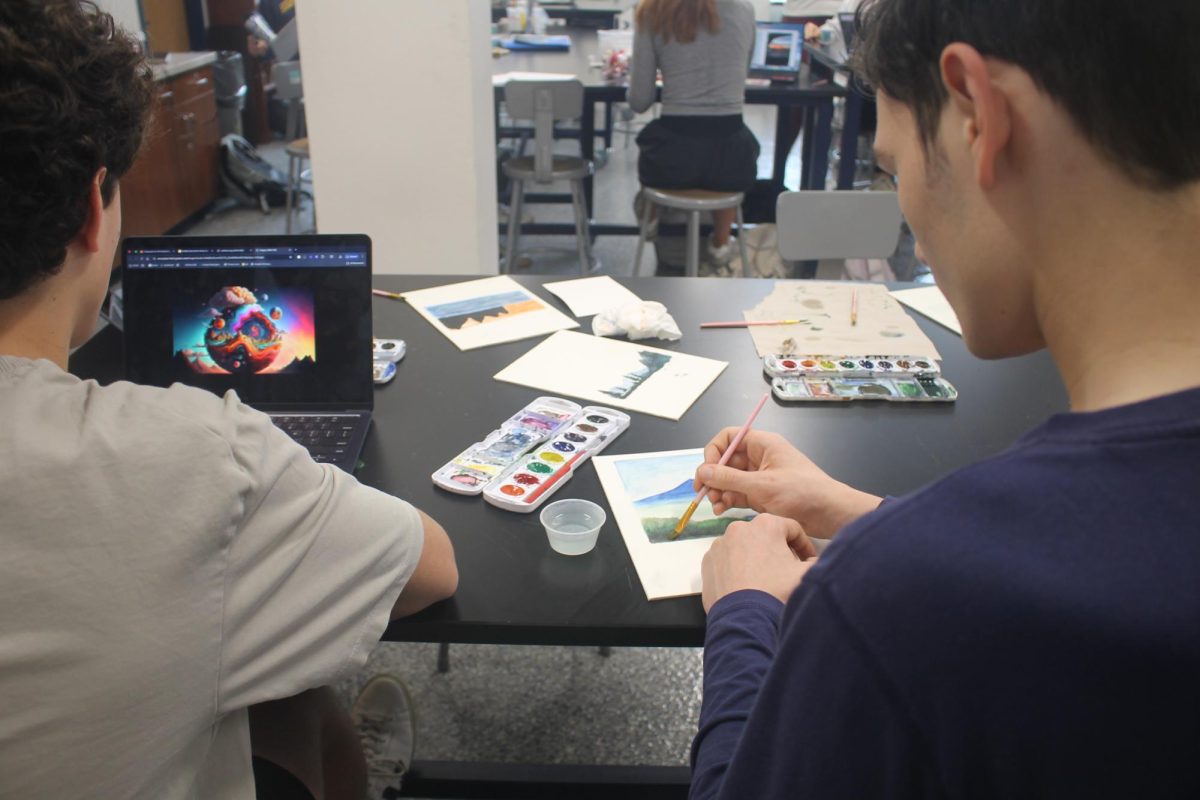
“I think AI is going to creep into every facet of how we do life, and that definitely includes the way art is made and perceived,” Art Teacher Jenai Talkington said.
However, some people don’t think that AI reshaping art is a bad thing. Craig Boehman, who has been a street photographer for almost a decade, has recently integrated AI generation into his photography.
“If you’re not using it, you’re really shooting yourself in the foot because AI allows you to have more control over those sorts of small, labor intensive sort of things,” Boehman said. “I don’t see it as any more than a tool, even if you’re using it to generate 100% or if you’re using it to generate 5% of the pixels on the screen.”
Critics of AI-generated art often argue that it requires little effort and therefore lacks authenticity. Under that logic, artistic value is tied to the amount of time and labor invested in the work. Supporters, however, question whether effort alone determines quality or meaning.
“We’re equating the more labor we put into [art], somehow the more artistic it is or the more authentic it is,” Boehman said. “The amount of labor that goes into it, it doesn’t matter. It shouldn’t matter to the viewers.”
However, while some see AI as merely a useful tool, others believe that AI is inherently inferior to traditional art.
“There is no substitution for human face-to-face interaction… being able to reach out and connect and have an actual human response back to you, it’s just something that AI will never be able to do,” Talkington said.
In addition to concerns about emotional connection, critics also point to visible flaws in AI-generated art. Many argue that these works often include distorted hands, uneven facial features and an artificial or plastic appearance that makes them feel manufactured rather than genuine.
“There’s this predictability in image making with AI that you just can’t get away from. You’ll never get this ‘outside the box’ [quality] that can only come from a human being.” Porter said
There have also been many concerns about AI’s copying of other artists’ works. Thousands of artists have reported that AI has copied their styles or artworks, and this has spurred a larger copyright and originality issue.
“I think there has to be a respect for copyright. I’m not sure how that works with AI,” Porter said. “I value that a person’s individual expression should be owned by that person, that artist, and that it shouldn’t be something that can be reproduced and mass produced.”
However, some also believe that AI, or at least technological improvements, were inevitable. As tech has improved over time, each improvement has come alongside people who opposed it.
“This argument has been going on since the beginning of time and especially in photography,” Boehman said. “The photography world upset the painting world because now just with a click of a button, you’re capturing an entire scene.”
Like photography once did, AI has stirred fears about originality, job security and authenticity. Supporters see it as a tool, while critics see it as a threat, leaving the future of art dependent on how creators choose to use it.
“I think AI is going to be the same disruption [as the internet]. Can you imagine our world without the Internet? Can you imagine art without the Internet?” Talkington said. “It’s not all bad, there are a lot of great things that happen, but I think AI is going to be the same disruption. I think it’s going to totally reshape the landscape.”