
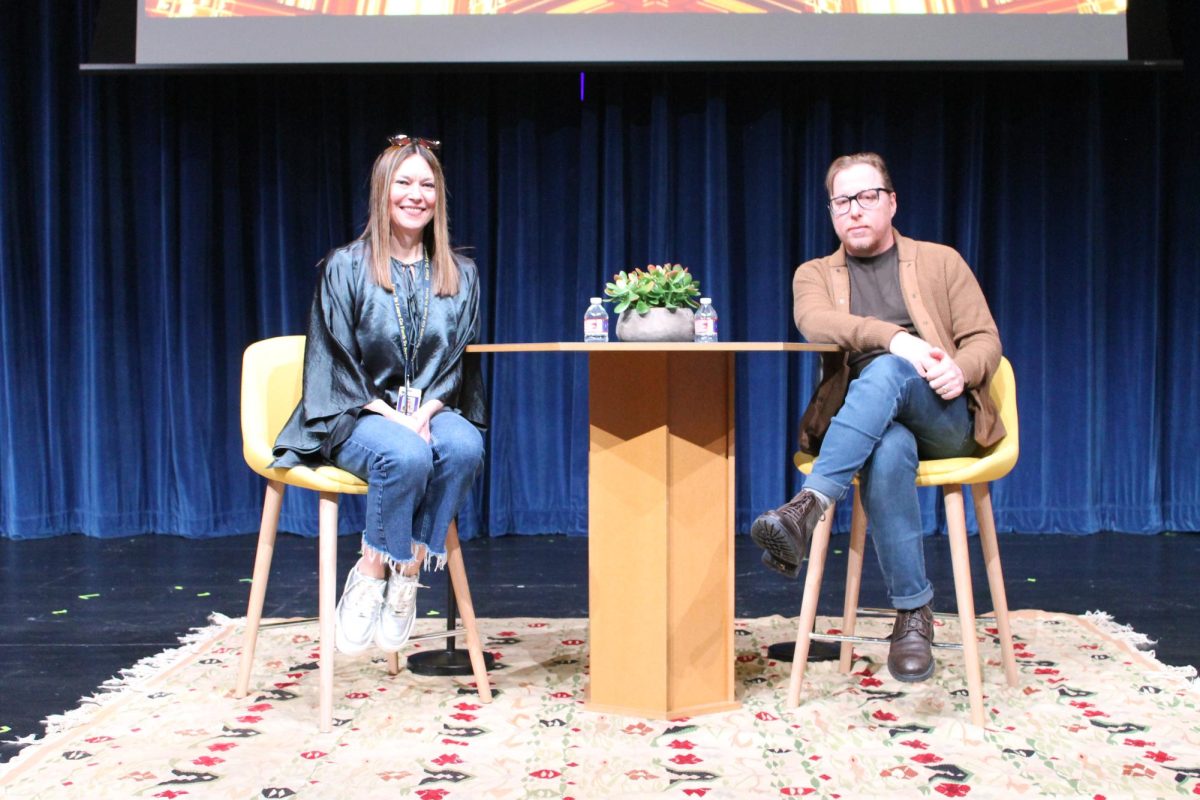
Before he was a world-renowned writer and show runner, Blake Crouch spent his youth conjuring stories that would surely scare his younger brother. These stories, while mostly oral memories, went on to inform his first novel and introduce him to the thriller genre.
“I love how a really well-crafted thriller can capture an audience and pull them along like no other story can,” American writer Blake Crouch said. “It can make them stay up all night long and evade their household tasks.”
Crouch’s initial books fall into the horror and crime genre, having not fully explored the science fiction elements that would later inform his most popular novels.
Although suspense came naturally, Crouch’s first completed novel was more on par with a Southern saga. Influenced heavily by Southern literary writers such as Cormac McCarthy, Crouch recommended The Road, by McCarthy, as one of the few books students should read.
“It was my first attempt at writing like him,” Crouch said. “Which was wrong because what I really loved were stories with more tension.”
Over time, he began blending that intensity with science fiction. His novels explore alternate realities, memory manipulation, and genetic engineering, but always through an emotional lens. Rather than overwhelming readers with dense technical explanations, Crouch works to simplify complex scientific ideas.
“My first drafts usually have way more science in them,” Crouch said. “But you have to skim it back. Readers don’t want to be too far into the weeds.”
To maintain accuracy, Crouch collaborates with the Science Entertainment Exchange, based in Los Angeles. This organization, while primarily for filmmakers, pairs creatives with experts in a variety of fields to help maintain scientific accuracy in their work.
“They’ll redline things, and we have conversations, so I’m not just relying on internet research,” Crouch said. “You can do research, and you’ll get a bunch of stuff back, but I feel like you still need a human being in the process.”
Dark Matter, the novel that gave Crouch international acclaim, is grounded in the principles of quantum mechanics. He uses the principle that a particle can be in more than one place at once to explore alternative paths one’s life may take based on a single decision.
“I like to think that there’s a version of me that got into law school and not waitlisted,” Crouch said. “I think about that version of Blake who’s practicing law in the south somewhere, and maybe he writes in his spare time, but maybe he never published.”
Instead, Crouch chose storytelling. One of his first “I made it” moments came when he received a voicemail from a literary agent interested in his work. Like many writers, this was the first yes after countless rejection letters he still keeps in a binder.
“I was at work and I called in and heard her message,” Crouch said. “I can still remember it, and how excited she was because I had sent her the book, she’s like, you’ve written a page turner.”
Though that page turner never reached print, it didn’t deter Crouch from continuing the writing experience. In 2024, Dark Matter was adapted into a television series on Apple TV, with Crouch serving as both writer and showrunner. The transition from novelist to showrunner made way for a new kind of hands-off decision-making.
“Every single thing on a set is a choice someone made. You’re constantly figuring out what matters most,” Crouch said. “I now have to make choices about whether to trust the people you’ve hired to make those choices.”
Despite his success, Crouch does not subscribe to the traditional idea of writer’s block. He believes that one is always able to write; it simply may not be what they want it to be.
“It just means you haven’t figured something out yet,” he said. “It doesn’t have to be dramatic.”
For aspiring writers, his message is straightforward: the work is difficult, but the reward is meaningful.
“If you commit yourself to doing it,” Crouch said, “it will bring meaning to your life.”