
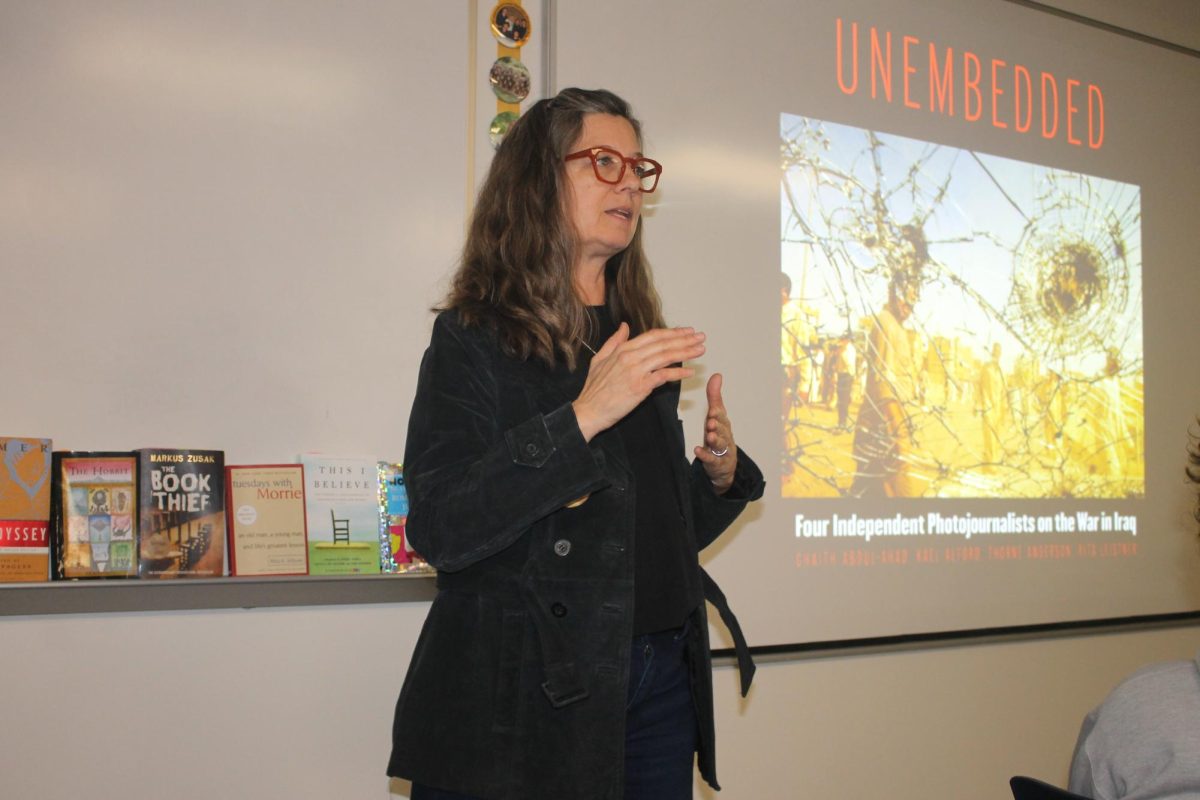
For photographer, writer and educator Kael Alford, photography is a form of poetry. In her LitFest presentation, Alford gave an informative workshop about how to depict major world events by photographing the daily lives of the people impacted.
After graduating, Alford declared that she knew she wanted to travel instead of sitting at a desk everyday. That’s why in 1996 she packed her bags and flew to Eastern Europe as a photojournalist to document the violent conflicts going there at the time. During her time there, she lived in Bulgaria and taught English to non-native speakers.
Alford confessed that she considered photography her passport. That’s why in 2003, she flew to Iraq to capture with her camera the ongoing tensions in the region. Independent of the U.S. military or American politics, Alford said she was interested in showing the world how those conflicts affected the civilians of Iraq. She concentrated her work into taking unfiltered raw photos of ordinary people in the middle of the conflict.
She then turned her attention to going back in time to the ’60s during the time of the civil rights movement and Martin Luther King Jr. Photojournalism in this time was particularly present to capture the different types of ongoing protests.
She showed the class different photographs from Bob Adelman, James Karales and Bill Hudson, photojournalists of this time. She asked students to then describe the actions that were present in the pictures. From peaceful protesters holding hands to hostile troops, these pictures captured the wide range of emotions and tensions of that time.
She then showed recent pictures dating from 2020. Even if six decades were between those pictures, multiple similarities could be found. The pictures from 2020 represented all the protests following George Floyd’s death at the hands of a police officer. A lot of the pictures were in black and white, referencing the civil rights movement in the ’60s. She used this topic to slowly transition to the main theme of her workshop.
Alford used the minutes remaining to express how during our current time, almost everyone can report injustice using their phone. She concluded her workshop by encouraging students to find other sources for news beside social media, like an independently owned newspaper.
Alford’s workshop had a real impact on students. As she was talking, one could really see how passionate she was about photojournalism, which was quite inspiring. She didn’t show just her own photos, but also a wide range of photos from different photographers throughout different decades. Hopefully Alford will come back to our school to inspire and lead even more students next year.