
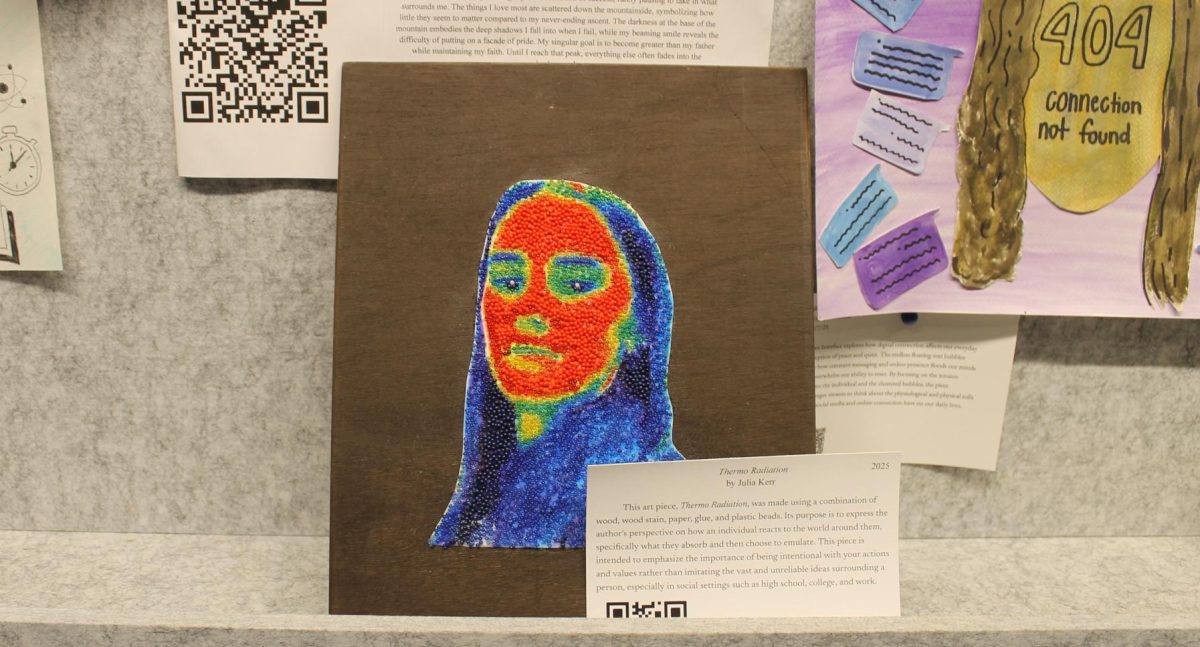
On the brink of leaving their communities for the first time after graduation, a group of seniors was challenged to define who they are as individuals. The class of 2026 seniors in TAG Literature accepted this challenge by creating self-portraits that depicted their true identities.
“We could use any medium we wanted, and it needed to be a self-portrait of ourselves. We also had to write an essay that went along with it and create an exhibition label,” senior Julia Kerr said.
The inspiration for the self-portrait came from an exhibition in the Smithsonian American Art Museum in Washington D.C.
“For two different years, I spent one to two weeks there, and we used art to design lessons that supplement instruction in history or language arts,” TAG Coordinator and AP Literature teacher Becky Adams said. “The most recent time I went they had an exhibit at the National Portrait Gallery called Eye to Eye: Self-Portraits Through the Years. That’s what inspired it.”
The goal for the self-portrait project was not to judge students artistic abilities but to provide an opportunity to apply their analysis skills in a creative way.
“The rubric focuses on skills central to literary analysis and intentional composition,” Adams said.
Furthermore, the project was created to challenge and help students reflect on their personal struggles.
“Senior year is already full of tension, college applications, life decisions and future plans so I wanted them to reflect on that creatively,” Adams said.
The project requires students to apply two elements from Burke’s Pentad, which is a way of analyzing human actions using five elements: act, scene, agent, agency and purpose, and incorporate the elements into their artwork and writing.
“The two [elements] I chose were agent and scene. We wrote about the tension between those two and how they interact. Mrs. Adams wanted us to explain what our self-portrait meant to us, why we chose the mediums we did and the sense of tension we wanted to express through it,” Kerr said.
In TAG AP Literature, the curriculum focuses on understanding literature at a deeper level. The goal of the self portrait project is to help students understand themselves better while also furthering their understanding of literature.
“Everything we do in AP Literature involves fiction – poetry, short stories and novels. The more we understand ourselves and our interactions with others, the more we understand literature,” Adams said.
The project was not the only focus in Adams’ class, so students had around three weeks brainstorming and creating their projects.
“I wanted to give them enough time to think, experiment and avoid rushing. The more time they spend reflecting and revising early on, the happier they usually are with the final product,” Adams said.
Students had around three weeks to complete the project, and most of the time was spent coming up with ideas.
“It took me a long time to come up with an idea because it could go in so many directions. But eventually, I figured out what direction I wanted to go,” senior Gracie Kong said.
Part of the brainstorming process happened in class while students shared their ideas with each other.
“Our class discussed the materials we might use for our self-portraits. Closer to the due date, we started sharing ideas about the deeper meaning and which parts of Burke’s Pentad we were going to use,” Kerr said.
Since most of the time was spent brainstorming ideas, some students gained artistic inspiration at random times outside of class.
“I saw someone on Instagram make a piece of art using seed beads on canvas,” Kerr said. “And I thought it was so pretty that I had to try it.”
The project also aims to help students grow in their understanding of art.
“We talked about the artistic process, taking risks and accepting that it doesn’t have to be perfect,” Adams said.
Each student has a display set up in the library with their self-portrait, exhibition label and a QR code to a Google Form for students and teachers to send feedback directly to the students, using school iPads.
“I really love the feedback aspect of the project. I usually encourage other teachers and administrators to visit the display, scan the QR codes and give digital feedback directly to the students,” Adams said.
Many students enjoyed expressing themselves in an artistic way through the project.
“Many [students] discover artistic talents they didn’t know they had or gain clarity about themselves and their decisions. It often leads to really creative and surprising work,” Adams said.