
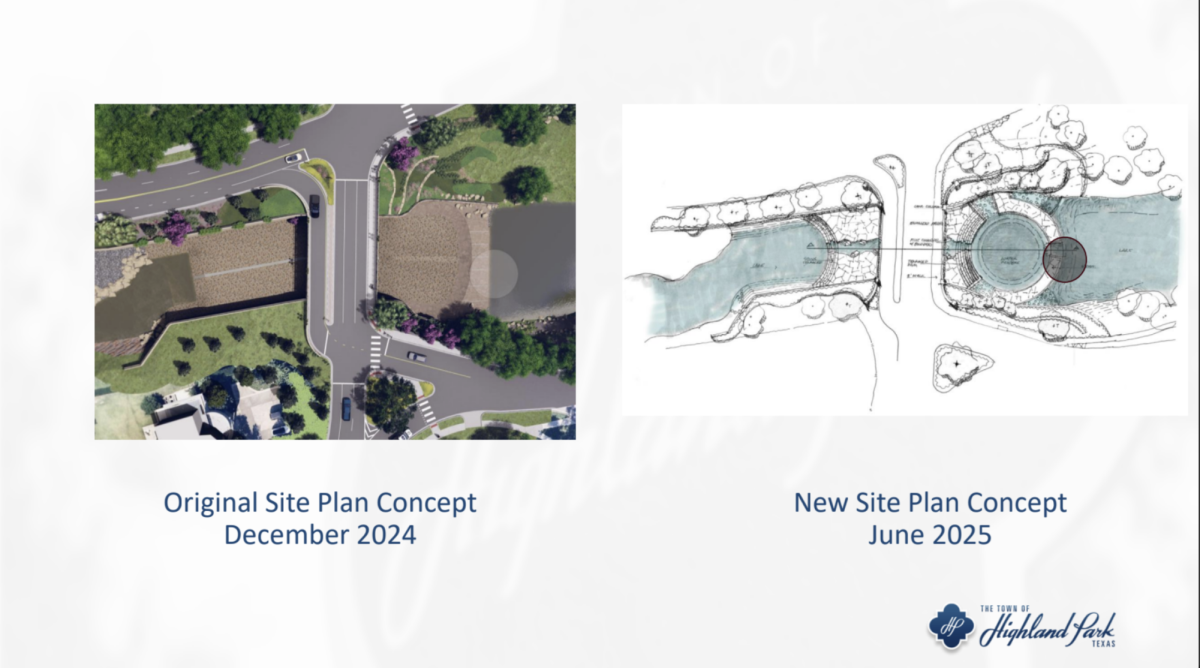
A new $22 million project aims to redefine the local landscape, ensuring protection for the community and wildlife. The project at Turtle Creek is the largest infrastructure effort Highland Park has ever done. The work will redesign the dam, roadway, and add new structures. The goal is to lower the dam’s flood hazard and make sure the town can survive a flood event.
The project has a set of clear goals; the main goal is to reduce the dam’s flood risk classification from high to low. It was classified as high risk by the Texas Commission on Environmental Quality (TCEQ). The dam will reduce flooding that is already there, a change that would help prevent any serious damage to homes and streets if something went wrong. Assistant Director of Engineering in Highland Park, Heather Cerda, has overseen countless projects, but this one stands out.
“This project has a little bit of everything, roadway reconstruction, utility improvements, plus a bridge and a weir structure,” Cerda said. “It’s a much larger-scale project than what we typically do.”
This project goes far then just upgrading the dam. It has a full reconstruction of Wycliff Avenue between Oaklawn and the town limit, a new bridge over Turtle Creek, and replacement, or upsizing water, and sewer lines. Also, a new weir, a barrier structure across a river that alters water flow, for control, and sewer lines. New landscaping, pedestrian facilities and aesthetic improvements are also part of the plan.
The project’s approval involves multiple state agencies, The TCEQ, represented by media relations Ricky Richter, reviews all plans through its programs to make sure structures meet state safety. Other state agencies involved are FEMA, TXDOT, USACE, the City of Dallas, and Dallas County.
“We review plans for proposed new dams as well as modifications to existing dams,” Richter said. “Dam owners are responsible for having a professional engineer have inspections of any construction work to see if it has approved construction plans, specifications and accepted engineering practices.”
The TCEQ involvement still remains even when construction is over. The agency will continue to monitor the dam and structures on a regular schedule, making sure everything is safe and stable long term.
“Dams are routinely inspected every 5 years,” Richter said. “And inspection reports with findings and recommendations are sent to the dam owner.”
The timeline of this project is that construction is set to begin in 2026 and will take about 20 to 24 months. Town administrator of Highland Park, Tobin Maples is ready for Highland park to undertake this project.
“This timeline enables comprehensive work and flexibility to accommodate public
safety, weather and utility coordination.” Maples said
Community engagement has been very important in this project. The town has a council group with residents and town council members, that meets to review existing conditions, revised design concept, traffic control, cost breakdown, and construction management. This has led to real improvements, like refining the weir, channel designs, and new pedestrian access with new sidewalks and crosswalks at important intersections.
“For the community, we created a working group for the area and held four meetings with them to go through each stage of the project, design, impacts, traffic, and appearance,” Cerda said. “We also held two large town hall meetings.”
The dam’s project process also includes a way for the public to get involved, making sure community input is there. The application needs public notice, giving residents an opportunity to submit comments.
“Water right applications for new dams require notice to the public, and the public has an opportunity to provide comments and participate in the permitting process,” Richter said
Streets including Wycliff, Fitzhugh, St Johns, Lakeside, and Turtle Creek Boulevard will be closed or have limited access at different points of construction, but not all. The town plans to set up detours, signs, and traffic control to keep things moving. Residents, businesses, and visitors will be able to get in and out, services like mail, deliveries and utilities won’t stop. Emergency crews will still be available, and the town will give advance notice if traffic changes happen.
“Emergency services, including fire, police and EMS, will always have immediate access,” Maples said “Coordination with first responders will remain a top priority to ensure swift response times and public safety”
The project will also have protections for the environment, where the water feature in the shape of a hole is located on St Johns drive. There will be new stormwater infrastructure to ensure the lake’s long term stability, and protect the nearby neighborhoods.
“The project will deliver protections for Connor Lake. By modernizing stormwater infrastructure and reinforcing the dam and spillway system, the improvements will reduce flood risks,” Maples said.
As the project soon starts to take place, it’s a major investment in Highland Park’s future. The engineering department and council are focused to protect the community, aiming to protect homes and streets.
“This project is about reducing that risk, reclassifying the dam as “low hazard,” Maples said. “And making sure Highland Park is protected well into the future.”