

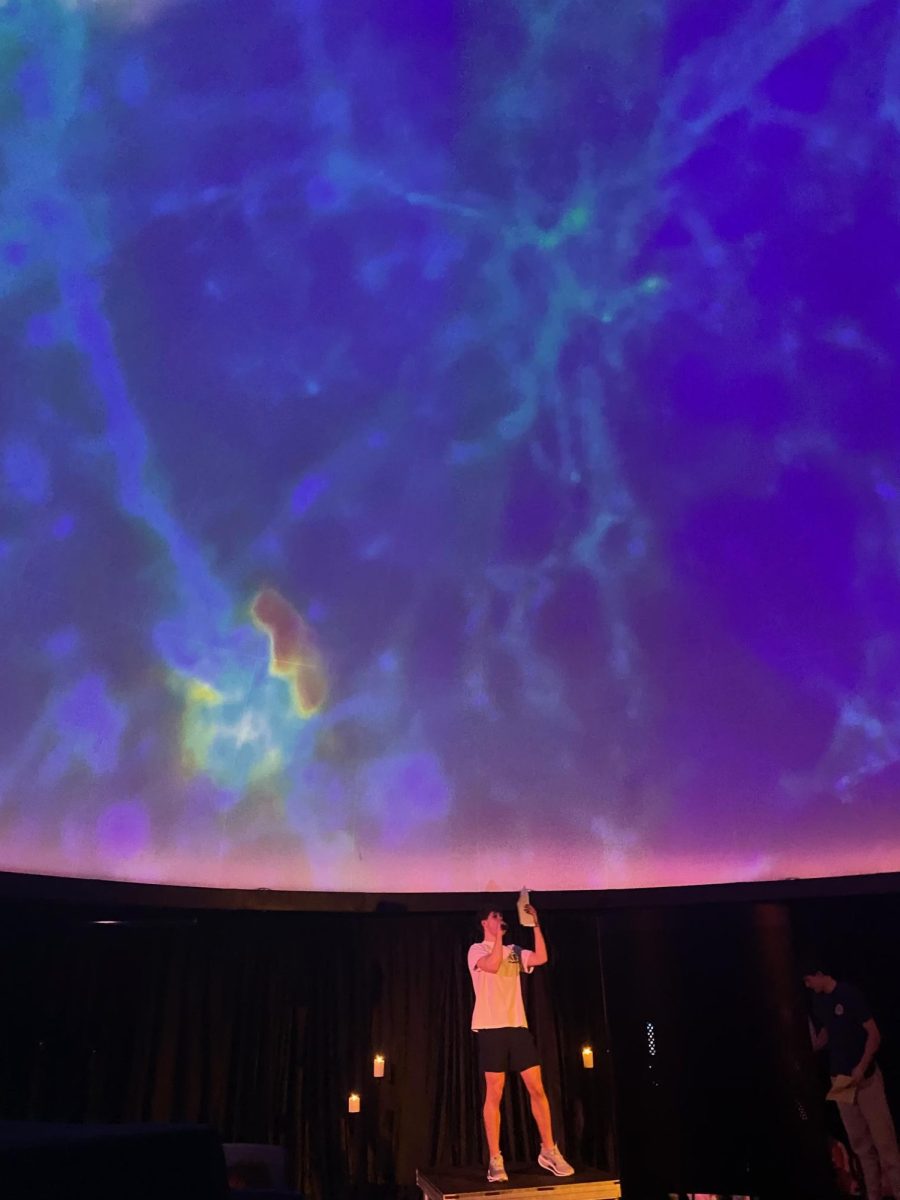
For decades, the Pierce Planetarium garnered childhood nostalgia as a dark room where students across HPISD could gaze at the constellations and stars. But, as the mechanical machinery of the 1900s was replaced with modern, digital technology, the dome stopped being a solely astronomy-based space, now capable of artistic and educational experiences.
“The planetarium was built in 1969,” Digitarium Curator Glenys Quick said. “It was very forward-thinking because the first planetarium was built in 1921.”
The planetarium originally used a Starball projector, which was renovated into a digital system by Dr. Geoffrey Orsak, Ph.D., and the MAPS program. The administration’s goal was to transform the planetarium from a science-based resource to a digitarium capable of displaying all subjects, ranging from cinematic scores to intricate arts.
“He [Geoffrey Orsak] could see the potential for not just doing space-related things here,” Quick said. “My background is in filmmaking, photography, that kind of thing, and of course I could see the potential too.”
Quick has worked with the MAPS department to host immersive concerts with renowned cellists, SciTech fest presentations, film festivals, and other student experiences.
“In October of 2024, I organized a film festival of short full-dome films, which we licensed through a distributor in Paris, very innovative short full-dome films that were featured in French festivals,” Quick said.
The shift from a flat classroom screen to a 360-degree environment can fundamentally alter learning perspectives, especially for art students. Thus, the Digitarium now offers students experiences that traditional classrooms cannot replicate.
“I know architecture classes have used it to actually take a different look at designs before,” district STEAM leader Bridget Myers said. “When you’re looking at something on a flat screen versus looking at it in a dome, it’s going to look and feel a lot different.”
The immersive environment does more than change how designs can look, but also changes how students comprehend material. By surrounding viewers with imagery, the space removes many typical distractions in regular classrooms.
“The Digitarium really forces you to be somewhere, and so that changes the design [of students’ art projects] because it really takes away from outside distractions,” Reynolds said.
As students become absorbed in the experience, teachers have noted that they see ideas from perspectives they had not considered before. This shift in viewpoint can encourage deeper thinking and creativity.
“Putting yourself in a situation where you can see something from a new viewpoint is hopefully just going to be able to open people up to different ideas, or open people up to learning things that they were having trouble with before,” Myers said.
Because of the stellar architecture, the digitarium’s dome allows for a resounding moment after every scene is watched, pushing students to reflect on their experience and tackle more complex questions and concepts.
“There wasn’t a given answer [students] had to figure it out,” Reynolds said. “And there is no right or wrong answer. So it led to more communication and them pondering.”
Beyond science instruction, the Digitarium has become a venue for musical performances and even poetry readings. As students engage with the visuals provided by the dome, their experience can be transformed into something that feels almost tangible and engaging beyond the classroom.
“It just brought up a lot of questions to really think about,” Reynolds said. “And it was just interesting to see what students thought the artist was doing and what they thought the artist meant. So even though it’s a movie, it was very three-dimensional.”
In addition to offering high school students opportunities to use this space, The Digitarium is frequently opened up for field trips.
“I heard my AP kids talking about the Planetarium and how they used to go when they were kids, when they were at the elementary schools,” Reynolds said.
Though the Digitarium has been hosting field trips for years, new technology has allowed trips to go beyond space and include 3D movies accompanying work done in multiple subjects.
“There are really innovative things happening there with immersive media, and I would love to have some kind of collaboration with students, making things for the dome,” Quick said.